Stack VS Heap in C
Stack VS Heap in C
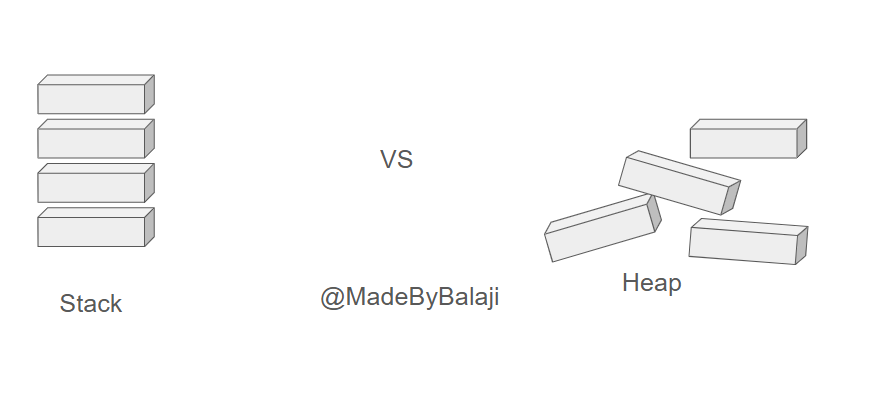
Stack VS Heap in C
Let’s do a full, clean, and crash-course explanation of stack and heap in C, the way you can ace firmware interviews. I’ll keep it practical for embedded firmware.
1. What is Stack?
- Stack memory is automatic memory.
- Used for: local variables, function calls, return addresses.
- Managed by compiler.
- LIFO (Last In, First Out) → last function called is first to return.
- Size is usually small, limited by OS / MCU.
Example:
1
2
3
4
5
6
7
8
9
10
11
12
#include <stdio.h>

void func() {
    int a = 10; // stored in stack
    int b = 20; // stored in stack
    printf("%d %d\n", a, b);
}

int main() {
    func();
    return 0;
}
✅ Notes:
- Variables
aandbexist only during function execution. - Memory is automatically released when function exits.
Stack Pros & Cons
| Pros | Cons |
|---|---|
| Fast allocation/deallocation | Small size → can overflow (stack overflow) |
| No need to free manually | Lifetime limited to function scope |
| Managed by compiler | Cannot resize dynamically |
2. What is Heap?
- Heap memory is dynamic memory.
- Managed by the programmer using
malloc/free. - Used for: dynamic data structures, large arrays, buffers.
- Larger than stack but slower allocation.
- Lifetime controlled manually, exists until
free()is called.
Example:
1
2
3
4
5
6
7
8
9
10
11
12
13
14
15
#include <stdio.h>
#include <stdlib.h>

int main() {
    int *ptr = (int*)malloc(sizeof(int)); // allocate on heap
    if(ptr == NULL) {
        printf("Memory allocation failed\n");
        return 1;
    }
    *ptr = 100;
    printf("%d\n", *ptr);

    free(ptr); // release heap memory
    return 0;
}
✅ Notes:
- Heap memory persists beyond function scope.
- You must free it manually, or you get memory leaks.
Heap Pros & Cons
| Pros | Cons |
|---|---|
| Large memory pool | Slower than stack |
| Lifetime can be controlled | Programmer must free manually |
| Can allocate at runtime | Fragmentation can occur |
3. Stack vs Heap – Quick Comparison
| Feature | Stack | Heap |
|---|---|---|
| Allocation | Automatic | Manual (malloc) |
| Lifetime | Function scope | Until free() |
| Size | Small | Large |
| Speed | Fast | Slower |
| Memory Errors | Stack overflow | Memory leak / fragmentation |
| Storage | Local variables, return addresses | Dynamic data, buffers |
4. Common Interview Questions
- Difference between stack and heap.
- What happens if stack overflows?
- How to avoid memory leaks in heap?
- When to use stack vs heap in firmware?
- How does recursive function affect stack?
5. Firmware Tip
- Prefer stack for small, temporary variables.
- Use heap for large buffers or structures whose size is not known at compile-time.
- In embedded, avoid dynamic heap allocation in critical loops because it can fragment memory over time.
This post is licensed under CC BY 4.0 by the author.