AWS's IoT services
There are multiple AWS services available for IoT, they are listed in this blog. For your reference.
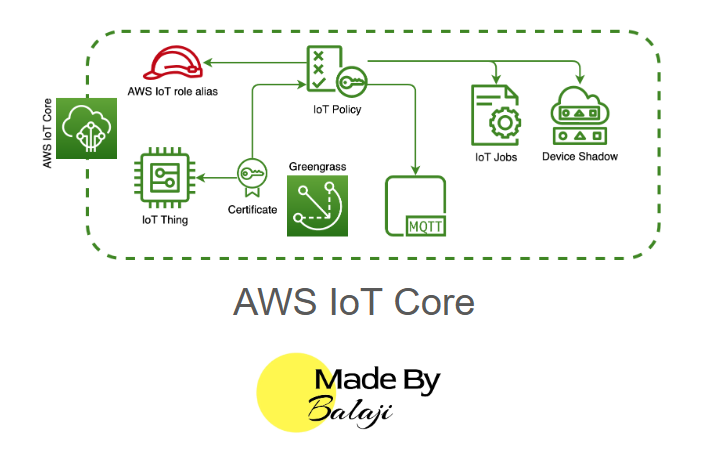
AWS's IoT services
AWS has a dedicated IoT service for MQTT communication, and Greengrass is like its local sidekick. Let me break it for you:
AWS Features for MQTT
AWS IoT Core
- The main AWS service that supports MQTT protocol directly.
- Acts like the MQTT broker in the cloud.
Your device (with FreeRTOS, ESP32, STM32, etc.) can:
CONNECT→ using a device certificate (TLS mutual auth).SUBSCRIBEandPUBLISH→ to topics likedevice/123/data.
- Supports QoS 0 and 1 (not 2).
- Also integrates with AWS Lambda, DynamoDB, S3, SNS, etc.
Example: Device sends
"Temp=25C"→ IoT Core → AWS Lambda stores it in DynamoDB.
AWS IoT Greengrass
- Runs locally on edge devices (like a gateway, Raspberry Pi, or industrial controller).
- It can act like a local MQTT broker, so your sensors can talk MQTT even if cloud is offline.
- Greengrass syncs data with AWS IoT Core when internet comes back.
Also supports:
- Local Lambda functions
- Machine learning inference at the edge
- Secure connectivity
Example: Factory sensors talk MQTT to Greengrass (local broker) → Greengrass later forwards aggregated data to IoT Core in AWS.
Other AWS Features with MQTT
- Device Shadows → Virtual twin of your device (stores last reported state and desired state).
- IoT Device Defender → Security & auditing for MQTT devices.
- IoT Analytics / Timestream → Stores and analyzes MQTT sensor data.
How It All Fits
- IoT Core = Cloud MQTT broker.
- Greengrass = Local broker + edge compute (offline mode).
- Devices use X.509 certificates + TLS to authenticate with IoT Core.
So, bro, if they ask in interview:
“What AWS feature supports MQTT?”
- Answer: AWS IoT Core (primary MQTT broker in AWS).
- If they ask about edge processing → AWS IoT Greengrass.
This post is licensed under CC BY 4.0 by the author.